The benefits of the long haul doctorate

This post is by Dr. Bethan Michael-Fox (@bethmichaelfox). Beth is an Associate Lecturer and Honorary Associate in the School of English and Creative Writing at the Open University. Beth and Jon (the host of this fantastic website) worked together for a few wonderful years at the University of Bedfordshire. You can find out more about Beth and her work and research at www.drbethanmichaelfox.com

I began a part-time PhD in January 2012, passed my viva mid-December 2019, submitted my amendments on Friday 26 June 2020 and got ‘the e-mail’ on Monday 29 June 2020: ‘It is my great pleasure to attach your award letter. Congratulations Dr Michael-Fox’! So, my PhD took me eight and a half years to complete. And what an eight and half years it was!

As Jon Rainford suggests and the Thriving Part-Time project serves to demonstrate, it ‘is likely that for most part-time PhD students, the doctoral journey will be paved with varied life challenges both personal and professional’. During my PhD I was a full-time lecturer, became a mother, took a maternity leave, managed a drawn out and stressful move 300 miles away, became a remote doctoral student, followed my loyal supervisor to four different institutions, changed jobs, lost two pregnancies, shifted from having my fees paid to self-funding, experienced anticipated and sudden bereavements, volunteered, partied, had the occasional teary meltdown, got married, and made a lot of friends.

There are wonderful people, including my brilliant husband, who’ve completed a part-time doctorate in four years, and many who do it in under six. This wasn’t how it went for me, but I think there are benefits to taking a longer time. So, what are they?

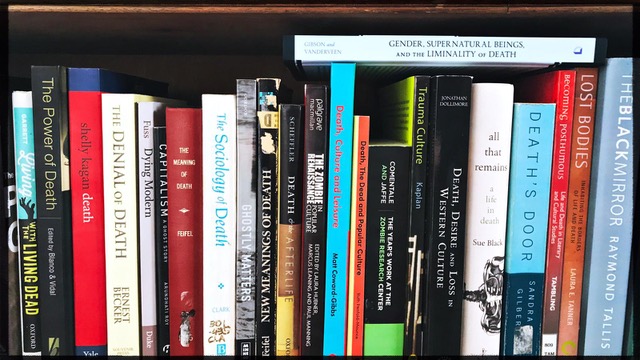
  1. You explore and discover. As Pat Thompson highlights, part-time doctoral students are more common in certain fields and often self-fund. This can mean flexibility. I started out thinking my thesis on engagement with death and the dead in literary and visual culture would be in English Literature. By the end of my doctorate I felt welcomed and embedded in the infrastructures of the emerging field of Death Studies, but it took me time to discover it. My research and my life are much richer for the friends, colleagues and interdisciplinary insights it has afforded me.
  2. You broaden your perspectives. I was reading both for my doctorate and the subject areas I taught in. This afforded the opportunity to engage in what Judith Butler calls ‘intellectual promiscuity’ and expand my thinking. I drew together ideas from disparate disciplines and was able to explore the ways in which ideas have flourished in divergent ways across systems of knowledge. I was delighted when my external examiner began my viva by commenting on how truly interdisciplinary my thesis was.
  3. You build robust networks. Working in a post-1992 UK university meant I was surrounded by inspiring colleagues completing part-time doctorates. They offered insights, facilitated ‘shut up and write’ sessions, and gently reminded me if I ever  veered toward defeatism that there were people completing their research in much more challenging circumstances than I was. What I didn’t have was a network studying death, or producing humanities research. Melanie Lovatt mentions co-convening a reading group to tackle the potential loneliness of the part-time doctorate. I started an online Zoom meet up once a month for postgraduates from any country, discipline or perspective studying death, dying or the dead. We’ve never missed a month and average between 6 to 10 attendees. These chats about life, death and research are often the most uplifting hour of my month!
  4. You graduate with super skills. I published along the way, honed and developed my writing style, proofread doctorates and read more on EthOS, edited a book, networked, presented at conferences, joined societies, completed projects, found people I loved co-publishing with, worked at two different universities, undertook projects, learnt a lot about myself and others, reflecting on the benefits and challenges of the process all the way through. It has given me a breadth of experience.
  5. You relate to students in new ways. Being a part-time doctoral student for so long has taught me a lot about empathising with and supporting students who are working, caring and studying. Undergraduate students have taught me an awful lot about manging these challenges too.

In reality, you can do all these things post-doctorate, or whilst completing swiftly. However, I don’t regret taking a long time. It gave me a pretty unshakeable sense of self-belief and confidence, along with a strong dose of awareness that one factor in my completing was plain good fortune and circumstance. There is stigma around taking ‘ages’, needing to resubmit, opting for a lower award or leaving all together. There shouldn’t be. The longer I took and more I learned about others’ experiences, the more I was able to uproot the myths I’d internalised about what ‘success’ was in a doctorate, or what it meant to have or not have one.

Do I have any advice? Not really! You don’t need it. You’re the one who knows your own situation, your strengths, the challenges you face, your most effective processes and preferred approaches. The one tip I would like to share is around comparing yourself to others. If I ever found myself doing this, it was helpful to ask: ‘are they in the same shoes as me?’ The answer was invariably no. I imagine it always will be for you. Though the support, solidarity, encouragement and community of others in similar situations can provide invaluable resources to continue, it is also true that our work, research, lives, approaches, personalities, experiences and aspirations are our own. They will shape, inform, constrict and enrich our experiences of the part-time doctorate.

Good luck with yours!
PhD by publication: because the whole is greater than the sum of the parts

Photo by lucas law on Unsplash

This post from Karen Campbell (@KarencampbellWP) follows on from her previous post ‘What is a PhD by Publication?‘ In this post, Karen addresses the benefits and challenges of pursuing this route. Karen is an education researcher based at Glasgow Caledonian University. She completed her PhD by publication in May 2020.

Why do a PhD by publication?

If you are an expert in your field with a significant portfolio of publications under your belt or are working towards developing such a portfolio, why not write for publication and complete a PhD, hitting two birds with one stone? The scenario described highlights the option to complete a PhD by publication through either a retrospective or a prospective route. I took the latter approach and worked to produce and publish academic papers around my area of work to reach the end goal of a PhD. The publication route to a doctorate is essentially about meta-analysis. It’s about abstracting yourself from the micro-level of your data’s detail and considering the macro themes emerging in your publications. This shows how the body of work you have selected is cohesive, original and adds value by way of an original contribution to the knowledge. It’s a challenge but one worth embarking on.

Benefits

  • I have developed as a researcher. Having to communicate the aims, objectives and outcomes of my research work in the form of publishable papers has meant that I pay more attention to ensuring that the paper’s claims meet my research objectives. I am more aware of the necessity to make my research questions explicit, include caveats about the limitations of the findings, and signal further research possibilities.
  • Writing for an international audience necessitates close attention to detail and developing a critical external eye. I have developed as an academic writer. Through practice, I am more able to present a clear argument relevant to the aims and objectives of the target journal. Moving forward, this has given me the confidence to engage with journal editors to discuss possible papers.
  • I am a more effective reviewer of journal articles and conference papers. Reviewing abstracts and papers involves a close mapping of the work presented to the conference criteria or journal aims and objectives. Thus, the review process has altered me to the necessity to communicate my own work according to strict guidelines.
  • My critical thinking and problem-solving skills have developed from writing for publication. This includes decisions about what to include and what to leave out, ensuring the argument flows, handling reviewer comments, working within word count restrictions and paying strict attention to detail around referencing.
  • Engaging in a PhD by publication also serves to enhance your project management skills. The process includes selecting the appropriate outputs to include, developing your thesis research question and planning your critical review, highlighting the impact of your work and including refection on the research journey.
  • My confidence has grown as I have published, and my academic profile has grown. My outputs have increased and have become more varied. I have had a book chapter published and am now blogging. I intend to write a capstone paper around my thesis and publish my literature review as a stand-alone paper. I feel that my outputs are valuable as they influence institutional strategy and, more widely, they have informed policy developments in the wider Scottish widening participation landscape.

Challenges

  • It’s worth bearing in mind that by the very nature of this route, you are not automatically hooked into support mechanisms available to those undertaking more traditional full-time routes – the help, advice and resources available through graduate schools, for example. Full-time PhD students also tend to develop social networks for mutual support. Academic colleagues completing professional doctorates or Education doctorates (programmes that usually contain a taught element) participate as part of a cohort. They tend to have a peer group to interact with and derive support from.
  • Doing a PhD by publication can be isolating. To mitigate this, I approached three research colleagues, all of whom had PhDs, to ask for their help to mentor me through the writing for publication process. Thus, I built my own mini-community of support that would not have been available otherwise. This proved invaluable, and I now feel able to offer the same backing to others.
  • Perhaps not unsurprisingly, the journey takes a huge commitment in terms of time. The day job inevitably becomes the evening and weekend job so there’s no escape.

Top ten tips

  1. Write papers with a PhD by publication in mind;
  2. Find an enthusiastic and supportive Advisory team;
  3. Appoint yourself encouraging, knowledgeable mentors;
  4. Do as much outlining and writing of the critical review before registering;
  5. Set aside time for writing and set writing targets;
  6. Select publications that fit around a general theme;
  7. Don’t include everything for the sake of it;
  8. Find your ‘golden thread’;
  9. Develop a research question for the thesis;
  10. Consider where and how you will include reflection.

What is a PhD by publication?

Photo by 4motions Werbeagentur on Unsplash

This post is from Dr Karen Campbell (@karencampbellWP) . Karen is an education researcher based at Glasgow Caledonian University. She completed her PhD by publication in May 2020. She  blogs about her research on GCU’s Academic Development and Student Learning blog site. Karen has published widely in journals such as Higher Education Research & Development, the Journal of Widening Participation and Lifelong Learning. Her paper, ‘How can universities contribute to the common good?’ won the Association of University Administrators’ essay prize in 2019.

What is it?

The PhD by publication is awarded to someone who has carried out extensive research over a significant period of time and who has a number of publications on related topics arising from this work which have been reviewed in high quality journals. It is a part-time route which involves a critical review of the articles by the author. The submission has to:

  • Demonstrate that the papers, when taken together, constitute a coherent whole
  • Show originality
  • Exhibit a sound command of established knowledge in the area
  • Make a significant contribution to the field

The point is that when analysed in such a way the papers become more than the sum of their parts. I see the PhD by publication as the topsy-turvy route to doctoral success. It is a degree awarded in recognition of an existing body of work, rather than at the end of a completely new research project. Effectively it’s a doctorate by RPL except instead of developing a portfolio you produce a thesis around your published research. To reference my own particular field, the process allows people who have not followed the traditional route towards a PhD to obtain recognition for the research they have done and the subject knowledge they have developed throughout their career. Thus it widens participation to doctoral level study. The route has a relatively long standing tradition in Europe, Australia and Canada but is less recognised in other parts of the globe although this is reportedly changing. Indeed in Northern Europe (e.g. Sweden, Finland and Estonia) it’s the norm for doctoral studies where candidates are required to publish three articles in peer-reviewed journals before being allowed to proceed to the viva stage.

Different universities have their own requirements but generally the submission will be made up of a collection of peer-reviewed books, articles or chapters which together form a coherent contribution to research. Joint publications are acceptable, subject to a clear statement as to the nature and extent of the relative contributions of each author. The submission must be of the same quality and research effort as that expected of a PhD by Research. The author is required to evidence that the body of work has a theoretical underpinning, is thematic, cohesive, contextualised to the wider literature and points to further research. It’s also about charting the research journey to highlight the development of key ideas over time and as such requires a significant element of reflection.

Is it a lesser doctorate?

Absolutely not, would be my response. Publishing from a thesis has always been an expectation of PhD level study. Yet, how many academics do we know who have completed doctorates via the traditional route but who have subsequently published little or nothing? This route allows both objectives to be achieved. Moreover, there is strong evidence that the model not only develops important skills such as writing for publication, responding to reviewer feedback and developing a research identity  it also offers a mechanism for universities to enhance their own research productivity by mobilising their PhD candidates to contribute more meaningfully to the research productivity of the university. The PhD by publication also positively reshapes what it is to be a doctoral student.

How many and which publications to select?

The straightforward answer is to select those papers that allow you develop your ‘golden thread.’ The outputs you select should show the development of your research over time, how and why the ideas emerged and the connections between them. It means stepping out from the detail of each paper and considering how the ideas and findings can be synthesised to create an original research question that relates to the body of work as a whole. For an excellent overview of how to review your outputs with the synthesis in mind read Susan Smith’s practical guide.

As to how many published outputs to include, there is no correct answer! Regulations vary from institution to institution and between countries. However, the rule of thumb is that quantity of published works submitted should be similar to the number of published works expected to result from an equivalent PhD by Research thesis in the subject discipline. Typically this may consist of either one or two books or six refereed journal articles, depending on the subject discipline and the length of the papers.  Seek guidance from your graduate school and other colleagues as to how many and what to include in the way of published works. In my case I selected five published papers based on three research projects two of which were automatically linked as one was a follow up study from the first.  The paper I selected as my starting point for my ‘golden thread’ was one which provided the context to the key argument – that immersion prior to entry enables widening participation to higher education. My contextual paper examines the role of widening participation for social justice and the common good. Subsequent papers were chosen to introduce the specific questions around widening participation my research addressed, each underpinned by a different theoretical perspective.  Developing my golden thread was, for me, the most important aspect of the entire process since, once I had it, I knew I was on track to demonstrating the triple whammy: coherence, originality and contribution.

How long does it take?

I’ve heard it said that the PhD by publication route is much shorter than the traditional one as all the research has already been done. I beg to differ. Consider the time required to complete the research, write it up into draft papers, submit these, address reviewer feedback and publish. Then there’s the time you need to reflect on the thesis’s originality, coherence and contribution as a whole to the body of knowledge. You need to develop your thesis research question and plan and write your critical review. The process also requires you to show the impact of your research and must include a significant element of reflection on the research and your findings; something else to factor in terms of time.

From the point of your proposal’s acceptance you are generally limited to a year’s registration to complete. If you count the time taken to carry out the steps above, however, and factor in work and other commitments the overall time is significantly increased. In reality it takes several years’ effort and, time-wise, often more than a traditional full-time equivalent.

Is it worth doing?

Absolutely, would be my response. If you are an expert in your field with a significant portfolio of publications under you belt or are working towards developing such a portfolio, why not write for publication and complete a PhD; hitting two birds with one stone? I took a prospective approach and worked to produce and publish academic papers around my area of work with a view to the end goal of a PhD. The advantage here (over the retrospective route) is that this tactic provides a focus for your research outputs. I found it helped my motivation to write thus avoiding the trap of always pushing publication to the side. For me, the PhD by publication provided a framework, a way forward from which I could see the path to submission.

My research diary: recording the twists and turns of a part-time doctorate

This post is by Dr. Julia Everitt (@juilaeverittdr) a Research Assistant in the Centre for the Study of Practice and Culture in Education (CSPACE) at Birmingham City University.  Julia has worked in education since 2001 including FE colleges and schools.  She moved into a research position in higher education in 2014 and worked on numerous short-term temporary research contracts before she secured her first full-time position in August 2017.

The complexity of research and personal life

Undertaking research is complex, messy, and not as linear as suggested by the timeline of activities we outline in project Gantt charts. During my doctorate, there were twists and turns as I made decisions around which literature to include and which theoretical approaches to apply. There were also the actions that arose from discussions with my supervisors and my response to the dilemmas, in negotiating access to research sites. Alongside my doctorate, my personal life was complex and messy – six years is a long time and during this, we moved to an unmodernised house and lost close family members to failing health and then bereavement. I used a research diary to record all of my reading, thoughts and decisions – the diary stored them in a central location where I could return when working on my doctorate amidst this complexity. This blog explores the idea of a research diary and its usefulness.

What is a research diary?

Silverman (2000) advocates the use of a research diary to record:

  • Research activities with dates
  • Your reading
  • Details of data collected
  • Directions of data analysis including ‘special achievement, dead ends and surprises’
  • Your reactions
  • Your supervisors’ reactions and suggestions

I had used a research diary during my MA dissertation and decided to continue with this for my doctorate. I started my EdD in January 2012 and between then and when I handed in my thesis in May 2017, I completed four research diaries, using A4 hardback-lined books.  Since then I have completed two more diaries, which makes seven in total.  I used the four diaries during my part-time doctorate for the following:  

Literature themes and visual interpretations: I explored 100 years of education policy through an online archive and textbooks that I could not afford to buy, so I made detailed notes in the diary. I also created visual interpretations including mind maps of themes from policies and timelines from key periods. I was able to revisit my interpretations as I read other literature to synthesise and make connections.  The notes are in date order, which makes them easier to locate. I would also annotate printed or PDF copies of articles and reports, then record my notes in reference software (e.g. Mendeley), but I would use my research diary to record my thoughts.

Emerging theoretical frameworks: The older policies have illuminating language including reference to social change (e.g. slum clearance) and I started to read sociology textbooks to make sense of this.  I made notes and visual interpretations of theorists’ views of society. I noticed the explicit and implicit use of models within the literature, which I drew into the diary or stuck in a printed version. These were my early noticing around the use of Bronfenbrenner’s Ecological Model of Development (1979) from the literature. I did not know that this would ultimately feature within my thesis – it was an early noticing and my diaries capture how this unfolded. I used images to understand and discuss the ontological and epistemological decisions that I made and represented these in my diary through an image around paradigmatic decisions that went into my thesis.

Supervisor interactions: I would take my research diary to my supervision meetings and draw on it to discuss my progress. I would share my thoughts, the models I had located or visual interpretations of theories. I tried to record the notes of supervision meetings but I found this difficult during the meetings so I would do these after. I would print out email feedback from my supervisors and stick them into the diary. This was useful as it records the discussions and decisions from these interactions.

Learning from events and networks: I attended events, workshops, and conferences run by professional associations (e.g. BERA, SRHE), doctoral colloquiums, symposiums at my own, and other universities. I created visual interpretations including mind maps of theories for instance Bourdieu’s habitus, capital and field to develop my own understanding. I attended events around viva preparation, publishing, academic writing and have revisited these notes at different time points. I would also make notes/thoughts of presentations about my research and capture academic details for future contact.

Methodologic dilemmas: It took a year to collect the data from my case study schools and I recorded the dates and attempts to access, the action I took and thoughts. I drew a mindmap of the planned and unplanned events, which delayed access to schools, an image that I used in my thesis. As I think about sharing the aspects of my journey, many aspects could be blog posts or journal articles from these diaries.

Analysis: I printed NVivo coding structures and captured this development in my diary. I coded the literature in the diaries with post-it note tabs as I undertook a content analysis of my interviews and moved back and forth between the literature and the data. As the literature was recorded together this made it easier to code than the individual items.

During my part-time doctorate, I found the use of a research diary to be helpful to record all of the twists and turns. My seven diaries are numbered and in date order so I can go back to any point easily to find my interpretations of an article, policy or theory. This is helpful when lives are complex when we are juggling work, a part-time doctorate and personal life. Therefore, when the time slot arises to continue this work – the research diaries make it easy to pick up where I left off the last time.

Finding balance during the part-time doctorate

Mr Grebo balancing work and sleep. Except it's my work with his sleep...

This post is from Selina Griffin. Selina has worked in data and project management and now works at the Open University and is in her mid (I can still say mid right?) thirties. She started a Doctorate in Education in October 2020 combining her love of data (in the guise of learning analytics) with one of her hobbies – Toastmasters. She tweets as @psylina and blogs about her study, her running and her cat (@MrGrebo) on Psylina Psays 

Why an EdD? Why now?

I chose to pursue a Professional Doctorate because I wanted to be able to “hold my own” and show that I can do what I do (have expertise in data, online learning and education) at an academic level. The difference between this and a traditional PhD was explained early on in our materials – a Professional Doctorate makes you a researching professional, a PhD a professional researcher. I considered that a Doctorate on Toastmasters may help me to “save time” by combining my hobby with my study; activities could in some way be linked to my study and so tick two boxes. In a Professional Doctorate this idea isn’t so unusual, except people usually are combining their work with their study. 

How

This is the big question isn’t it, how? How do you work 9-5 (ish), do all the home-life stuff and find the 18 or so hours a week needed to study? Well if that is your aim – to just work, study and do family commitments you’re going to have problems. There’s another important category you need to consider, You.

1.Enjoy your study

Firstly, I do enjoy studying. And you have to at this level. You’re not in compulsory education, you’re making a choice so I’m afraid you are going to have to enjoy it or you haven’t got a hope in hell. I’m not saying I always enjoy it obviously, particularly when I’m struggling with an assignment or grappling with a paper or a concept I can’t figure out, but you need to be excited about what you’re doing and enjoy it. I would almost class study as a hobby; which is perhaps demeaning, but by this I mean when I have free time, study is an option – it’s a choice and not the same category as work

2. Belong

Being a part-time researcher, you can struggle with your identity and your motivation. It can feel isolating and like something “extra”, rather than who you are. You are just as much a researcher as someone who is full-time. Own it (it’s all over my blog!). Make it part of your identity (I put it in my signature after my job title and on Twitter!). Networking with your cohort can help, I do this by attending a monthly seminar – it works for me because there’s a seminar to listen to, it’s not “social chat” and it involves students in all years so I can get a sense of progress and the wider community. A weekly pub quiz may not work for you, but find something – or set something up

3. Find your you

That doesn’t mean all I do is study, I have this “You” category too: I do Toastmasters. I hug my cat. But I also exercise and run (including marathons). I run because it helps me to run. What I don’t do is watch hours of TV – there are a few shows I watch and films, but I don’t “veg” watching TV, it has to be doing something for me.

When you work at a computer, then study at a computer and it’s lockdown, I need a break! I might pop out in a lunch hour (I usually do some sort of exercise at lunch, a 15 minute exercise video, just something to take a physical and mental break and still have time left to eat!) or when I close my work laptop for the day. But I also enjoy it, it feels decadent, I can listen to podcasts (and Zombies, Run), enjoy my own space my own ability (separate from work or study) and set and achieve challenges (the satisfaction of a virtual race is still a huge thrill for me!). 

4. Balance

I use running as a motivation (just read 1 more paper then you can run) or a tool to help me focus (now you’ve run you can study for a couple of hours) – the approach depends on the priority for the day and other commitments.

5. Allow for Eureka moments

It’s a cliché, but I do think clearly when I run and a work or a study problem will often unpack itself and present a solution, so once I’m back, I make notes. I have a Trello board for study and I add cards (even on my phone so I don’t have to go through the hassle of turning a pc on) to ensure I capture and remember key ideas or trains of thought as I come to them for processing later in my study time. This also helps my “completionist” tendencies because having separate cards (or lines on a to-do list) I can tick them off as I move through and address the point.

Own Institution Doctoral Research: Evaluating total Immersion

This week’s post is from Sharon Inglis (@sharoninglis) a Senior Lecturer in Education, and course leader for FT and PT MA Education.  Her thesis investigated the expectations and experiences of part-time students in transition into taught postgraduate students, and the staff who taught them.  Her viva was in January 2020.  The student participants were her PT MA students, and the staff who taught them were her colleagues.

Photo by Karolina Grabowska on Pexels.com

It can be really challenging to be a doctoral student in the institution where you work – particularly if you are completing a Professional Doctorate researching your own practice, and working full time in your setting.  Total immersion in your studies is a given, but it can be something of a double-edged sword.

Advantages

  • Staying focussed really isn’t a problem, because your topic is all you ever think about and (almost) all you ever do.  Critical engagement with the literature becomes second nature, because your subconscious brain is two steps ahead of your conscious one
  • There is no such thing as wasted effort in either the day job, or the research (unless it’s admin that isn’t best use of an academic’s time).  Everything relevant counts towards one or the other – and on a good day both.
  • You are most certainly immersed in your data because you have lived and breathed it, both as researcher, but also reflected on it (and possibly acted on it) as a practitioner, too.
  • Your recommendations write themselves.  Your data screams at you!  You know what needs to be done, and by the time that you have submitted, you’re already half-way to evaluating your first attempt at implementation.

Disadvantages

  • Total immersion means that here is no escape from either your doctorate or the day job.  Any boundaries that you might start out with can soon crumble; and, when the going gets tough it can be hard not to resent both the day job and the research for the reciprocal time burglar that each becomes from the other.
  • Because your research and your day job are closely intertwined, it can be difficult for colleagues and management to be as sympathetic to your research than if you are doing something completely different.
  • If you are researching your own institution’s students, you need to be particularly careful about perceptions of power.  Will your participants respond differently to you if they perceive you as a member of staff first and a researcher second.  This is participant bias.  You can go a long way to dismantling this by making sure that all your information and consent documentation make the anonymity and confidentiality of their participation very clear, and re-iterate this at every possible opportunity.
  • If your participants are your own students, then there is an added layer of complexity about your dual role.  Sometimes students can find it difficult to distinguish between you as lecturer/tutor/ course leader, and you as researcher.  If this happens, there’s a significant possibility of participants telling you what they think that you want to hear, so it’s really important that your own students understand that their participation (or lack of it) have nothing to do with their progression on their course.  Again, you can use your documentation and each interaction with your students as participants to reinforce this.  Interestingly, my own students told me things as a researcher that they had never told me as their lecturer; and never mentioned to me as their lecturer again, outside of their participation in my research.

Take-aways

  1. Consideration in your thesis of your positionality in own institution makes a great start to a section of reflexivity.  The things that you have to think about, and how you overcame them are great thesis material.  Just remember to capture what you did, before you forget!
  2. Ring-fence your time, and set clear boundaries for colleagues and students.
  3. Manage expectations.  For students, book your leave and communicate it well-ahead.  For colleagues, and anyone else who might be emailing you, have a polite, but firm OOO response in time that you have committed to writing.  Provide alternative contact details for your non-contact time.
  4. If, like me, you have spent years trying not to sweat the small stuff in life, it’s time for a re-think.   Learn to sweat the small stuff, and remember that as a part-time student, you eat the elephant that is your doctorate one bite at a time.  So, if you’re someone who thinks that they can’t do anything if you have less than half a day available, think again.  Turn this on its head, and think about what you can usefully do in a small chunk of time.
  5. Keep your eyes on the prize.  You are investigating your own practice, because you are passionate.  If you didn’t care about it so much that it hurts, you wouldn’t be doing this.  Breathe deeply, stick with it, and remember that the double-edged sword can be instrumental in bringing about both a doctorate for you, and a better experience and/ or outcomes for your students

Part-time PhD: portfolio approach to an academic career

Photo by Anete Lusina on Pexels.com

This weeks post is re-published with permission from the Think Ahead team, and the author Melanie Lovatt (@melanie_lovatt). Originally posted on the Think Ahead blog.

Back in 2010 I excitedly told friends and family that I had decided to do a part-time PhD. “Part-time?” repeated a relative sceptically. “Well, how long’s that going to take you?” “Around six years!” I replied, with an enthusiasm that I suspected might desert me long before completion. But five years and nine months on, having passed my viva with minor corrections last month and about to start a lectureship, I can honestly say that doing my PhD part-time was the right decision for me. Here are some reflections on the process:

Why do it part-time?

There are many reasons why someone might want to study part-time, e.g. financial reasons, existing work commitments, or family responsibilities. Mine were largely financial. I was already working as an administrator at The University of Sheffield when I considered postgraduate research and was able to register as a staff candidate, where I paid no tuition fees but received no stipend. If you work at a university and are considering doing a PhD, it’s worth investigating if your institution offers something similar. It definitely worked out for me. As well as the huge incentive of paying no fees, I’m convinced already working in an academic environment secured me interesting and useful employment I might not otherwise have got, which leads me to my second point…

Doing paid-work alongside my PhD

Not having a stipend meant that I needed paid work alongside my PhD to pay the rent. For the first couple of years I stayed in university administration, which gave me valuable insights into the inner workings of academic life and ‘how things get done’ in a university. From there, I was fortunate to get a position as a part-time research associate (RA) on various projects in different departments. This was not without its challenges…

Getting up to speed with entirely different bodies of literature on subjects with which I was not already familiar was difficult. It also sometimes meant needing to juggle my time and other commitments around in order to meet deadlines, although this worked both ways. For instance I once switched to working full time as an RA for a month so I could submit a report on time, but then took the next month off in lieu to work on my PhD. Having supportive line managers helped with this.

Despite these challenges, working as an RA on projects alongside my PhD was overwhelmingly positive. It gave me experience of working in multi-disciplinary teams, applying my methodological skills to different fields, writing and publishing journal articles, and applying for grants. So, while it may have taken twice as long to get my PhD than if I had done it full-time, I was filling my CV along the way with the skills, experience and achievements that I needed in order to secure an academic position. Doing those other jobs also gave me some helpful perspective on my PhD, in particular steering me away from any misguided notion that my PhD would ever be perfect. (It isn’t, though nor would it have been even had I spent another six years on it.) As an RA, I frequently had tight deadlines where I had to submit a piece of work that I thought was good enough rather than perfect, and this definitely helped me when I approached the final stages of writing my PhD.

Maintaining enthusiasm

I once heard someone describe doing a PhD as ‘a slog’. He was talking about full-time study, so I’m not sure what term he would have used for a part-time degree. It’s perhaps not repeatable. It’s certainly the case that six years is a long time to sustain enthusiasm for a topic. I had a gap of five years between finishing my Masters degree and starting my PhD, and am relieved that I waited until I had come up with an area of research that I was genuinely interested in. I think my part-time paid work on other projects also helped to maintain my commitment to my PhD. Rarely spending more than three days a week on it meant that I never really got bored of it. Switching between my PhD and my paid work each week could be difficult, but on the whole I think it helped me to stay focused and make the most of the time I did have to spend studying.

Staying social

I’ve heard many people describe doing a PhD as an isolating experience. I actively worked to avoid this. As a part-time student I had no access to a permanent desk in the department, and so studied from home. This meant that, apart from my monthly supervision meetings, I was an infrequent visitor to the department. (This instilled in me a lingering insecurity that I was not a ‘proper’ member of the department. Consequently, convinced that staff would not remember me, I always felt compelled to remind people of my name, until the time when one lecturer, in obvious bewilderment and impatience said, “I know who you are! We’ve met several times!”). To try and redress this and feel like a member of the department, I attended as many departmental seminars as possible, and also co-convened a reading group. I am also lucky in that my fellow PhD students are a lovely, sociable bunch, and we have regular catch-ups over drinks where we share experiences and provide peer-support.

I do think I’ve been fortunate with the opportunities I’ve had, and if my part-time work had been merely to pay the bills rather than develop my skills as an academic, I’d probably have a very different perspective. Doing my PhD part-time worked well for me though, and it was definitely worth the wait.

Part-time PhD, a weighty chapter in a bigger book.

Sam's multiple workstations.png

This weeks post is re-published with permission from the Think Ahead team, and the author Sam Dent (@SRDent89). Originally posted on the Think Ahead blog.

My PhD topic area is based in my experiences of working on the front line of University Student Support. Each March I’d brace for impact as swathes of 20/21-year-olds about to graduate would come to see me; exhausted/tempted to withdraw, and questioning the purpose of their entire education. At this point in the year most graduate recruitment schemes had announced their new recruits, and inevitably some students didn’t make the cut. For many of these students this was the first time they had realized that beginning their career would not be straightforward, and that being successful had not come easy this time.

This work is perhaps where I became fitted for part-time study, (Masters and PhD) equipping me with the grounded perspective that little about careers is smooth and linear. My career so far has been thematic… but initially broad, mainly focused around governance, then Higher Education (HE), balancing work in professional services with a personal interest in academia, and increasingly interests in social justice, and inequalities (You can find the detail here on my LinkedIn).

However, there are some old fashioned thinkers who would suggest we have failed to specialize or settle down; we’re intrepid explorers people! Boldly going where others haven’t, approaching things from new and creative angels. Pass me a scarlet letter if you absolutely must, but I’ll wear it with pride ultimately my career has involved doing many things at once, things that I enjoy, find interesting, and am passionate about.

My PhD is but one very significant strand to this. In my experience a PhD is not necessarily a zero sum qualification, you get or you don’t. By doing a PhD you are making yourself more informed, broad-minded, inquisitive, well-read, articulate, creative, exposed to different people and cultures, and these are all skills and experiences I have found myself relying on in the last three years; as well as acquiring a greatly expanded rolodex! I have held three fulltime roles since starting my PhDeach a promotion or development opportunityand each enhanced by the developing skill set and network which can be traced back to my PhD.

At times though, I need to compartmentalise elements of my career in ways that other researchers perhaps do not. My multiple email accounts, to service my multiple roles, are one way that the boundaries are drawn. Scenes like this are not uncommon;

Q: “How many email accounts do you actually have now?”

Me: “I haven’t counted till you asked but apparently it’s 6 atm 😝”

The above is from an email chain where I redirected an enquiry from one of my accounts to the most appropriate one. The HE sector can be deeply political, nobody has taught me this, or instructed me to draw these boundaries, but I’ve become very aware of the potential challenges of studying an area you work in. The views you express through academic pursuits as a researcher, may earn you respect in one sphere and be accredited to your academic rigour, independence. Yet in another sphere this might ruffle feathers as you fail to tow the party line or speak in an unfamiliar language. In a third sphere a middle ground maybe perfect; delicately balanced to help conceive how impact can be generated from your research findings.

I feel I am acting as the spoke in the middle of wheel which brings together academic research in ways which lead to practical applicationsTo an extent it’s about being clear about what sphere your operating in, and who your audience is and perfecting your use of language and demeanour to suite your audience; a complex skill constantly developing, but a highly valuable one.

Studying what you know and what you do, while you do it, is deeply complex especially as you try to maintain integrity, and juggle these different sphere. Very similar to how Clegg, Stevenson, and Burke (2016) have characterised the challenges of researching for evidence-based policy making purposes while trying to maintain academic credibility, navigating the challenges to one identity which comes with this and the real potential for “slippages of translation and loss of criticality”.

I do not want to scare you away from Part-Time PhD study, especially for professional development, however it is an issue which keeps you on your toes. I won’t here recount specific examples of how political and complex the HE sector can be. But I’d suggest you look to Vicki Bolivar’s recent talk where she talks about her complex journey influencing policy and politics of Higher Education. Bolivar is a maverick whose research is fundamentally changing the face of HE, my experience has been a very different reflection of our differing career stages/focuses.

But challenging as this may be, doing a part time PhD is the best thing I have ever chosen to do.

My PhD has become one of the most rewarding things I have entered into, it has; introduced me to some excellent people, fascinating conferences, lifelong friends, mended broken hearts, and shaped my life in ways I’m not sure would have happened otherwise. I may not have some of the stability, and pension plan if I’d been snapped up by a graduate recruitment scheme at 21, but I certainly think I’ve had far more fun.

Read more from Samuel Dent via https://samueldent.wordpress.com/

Part-time PhD at career end. Why did I do it to myself?

Photo by Catarina Sousa on Pexels.com

This weeks post is from Katherine Christian (@KatherineChri15) from Federation University Australia. Her research interests focus on Early Career Researchers in the Sciences and you can find out more on her website

I did my PhD part time, and as a remote student with supervisors at the end of email and on regular video calls. This was less than ideal, but if it is the only option, it is still worthwhile.

My PhD studies came towards the end of my career, over 40 years after my undergraduate degree, rather than at the beginning. Unusual, perhaps, but during my career in management of medical research I had seen evidence of the very difficult work environment for early career researchers (ECRs) in the sciences in Australia and I wanted to do something about it while I could. My PhD project involved exploring the challenges for these ECRs, who were working in universities and independent research institutes, and their impact on the scientists’ job satisfaction and their intention to leave academic research. The advantage of making waves towards the end of a career is that it doesn’t matter if you create trouble for yourself and you can take advantage of having friends in high places. I have recently submitted my thesis, but I hope to continue this research on a part time basis, particularly exploring the environment during COVID-19 and looking more closely at the impact on ECRs of questionable research practices and poor leadership supervision which have emerged as major problems.

Having made the decision to do this research, part-time, while continuing my two part-time jobs in research, I needed to find a supervisor. That was actually very difficult. My PhD research was interdisciplinary, being about scientists but not actually science, and it didn’t seem to “belong” anywhere. Eventually I found Wendy, a scientist with an interest in higher degree education, who was able to help me over a second obstacle: that I didn’t have a higher degree. Fortunately, I did have research experience, had worked in scientific academia and I had recently published a text book about research management. I was underway, flying towards the next set of hurdles.

Wendy’s university was in another state, in a regional Australian university, spread (as were my supervisors) over three campuses. A campus visit involved catching a plane and a train, or plane and car journey, so I only visited four times in three years.

My introductory visit was a baptism by fire into the perils of interdisciplinary research. Wendy the scientist was away, so I met only my two other allocated supervisors, both social scientists. It was a very difficult meeting. They didn’t understand my world of science and had no experience or understanding of the environment I was concerned about. I didn’t understand theirs. We spoke an entirely different language! The last straw was being told social scientists don’t believe in evidence in the way scientists do, but instead simply use it as a starting point for considering the views of individuals. The fact that I was very senior in my professional experience while a rank amateur in social science academia proved very challenging for all of us. I felt I knew all about my topic, and not only knew what my question was, but its answer as well. The prospect of immersing myself in the literature for a year was torture, but the supervisors were insistent, and I was slowly brought into line and shown the “academic way”. Of course, this approach did end up being valuable. While it didn’t add greatly to my knowledge of the problems (which sadly were reproduced in various guises across the world) I learnt a lot about academic writing and the many forms it takes.

I had regular video calls with my supervisory team, but I was largely on my own in between. I took up all online courses and resources offered by the university and I was sent on a course to learn about qualitative research, which was very beneficial. In retrospect, it was quite a lonely experience being both part-time and remote. I missed the opportunities that come with being immersed in academia and I didn’t get to meet many other students. I couldn’t, of course, pop in to an office to ask any of my supervisors a quick question or bounce ideas with other students. COVID-19 helped my circumstances. Suddenly the university had to offer resources to students working at home and I was consequently able to participate in on-line seminars and in a writing group. I came to know some of the other students and to learn about their work and I felt a little more that I belonged. I wish I had had these opportunities from the start.

Three years of steep learning curve on all fronts, a change of one supervisor to another who provided a bridge between science and social science, and a lot of patient support from the whole supervisory team has brought me to the end of the journey. Would I do it again? Definitely. I have learnt a whole range of new skills, had my eyes opened to different ways of thinking and I have successfully “rocked the boats” I was wanting to rock. It has been very satisfying. If in doubt, I say do it!

Key points for the remote student – involve yourself as much as you can with anything which puts you in touch with other students or early career researchers, and take up all the training you are offered. The training will bring you in touch with other students and alert you to new ideas and approaches. The same applies to conferences – these days usually held by Zoom. Accept opportunities to present and to attend, and broaden the horizons which will otherwise be limited by your remoteness.

We want your stories too!

Photo by Pixabay on Pexels.com

This blog is a collection of blog posts by a range of authors. They come from those who have completed or are undertaking part-time doctorates. Its content is therefore only as rich as the range of contributions. If you do not see yourself or people like you represented, we’d love to include a piece by you. If you have experience of supporting part-time doctoral researchers supervising PhDs would also love to hear from you.

You can see from the posts we have already shared that they come in a variety of styles and formats. What we want to develop is place where current and future doctoral researchers can find inspiration though the experiences of others. Our editorial policy is light touch, and we will work with you to shape your ideas if you are not quite sure what you want to share. 

We are particularly keen to feature pieces from:

  • People working outside academia 
  • Lab based part-time students 
  • Global perspectives
  • Those under-represented in higher education
  • People who have paused, resumed or abandoned part-time doctorates
  • Those doing doctorates but not planning on careers in academia

This list is not exhaustive and all ideas and perspectives are welcomed so please do get in touch. You can get in touch with through the contact form 

Some general guidelines for writing a good post

Title: Ideally something snappy that addresses a question a student might have or speaks to a specific issue they might face

Author details: A twitter handle and any other method you might be happy for them to contact you on. It would also be good to have a couple of sentences saying who you are / where you are from and your relationship to the part-time doctorate.

Length: 5-800 words is a good length 

Do try and include: 

  • A short introductory paragraph spelling out the issue you are discussing 
  • A takeaway message at the end if possible
  • References hyperlinked in the text

Format: Microsoft word 

Publication: We schedule a post weekly so there may be some delay between acceptance and publication but we will let you know when it will be published and promote it both on twitter  so please include your username if you have one. 

Deadline: This is an ongoing call so there are no hard deadlines

The part-time doctorate: when time flies and stands still

Photo by Giallo on Pexels.com

This post is from Nicole Brown. Nicole is a Lecturer in Education, who embarked on a part-time doctoral journey as a (very) mature student. In her contribution she writes about the flexibility of time, as she has experienced it in her studies. She tweets as @ncjbrown

Doing a doctorate is difficult, engaging in that research as a part-time endeavour even more so. Drop-out rates amongst doctoral students are generally very high, but studies show that nationality, marital status, age, disciplinary research field and funding all play a part. And with that as someone who was working, older and not an English native speaker I was highly likely to not complete my studies. However, for me, part-time “doctoring” was not all doom and gloom. If I was to summarise the main concern and the main advantage of my experience of a part-time doctorate, it would be that time flies and stands still, at the same time.

I was no youngster, when I started. In the UK context a mature student is aged 21 or over at the start of their studies. Well, aged 39 when I started my doctorate, I was definitely an atypical student in my chosen institution. I didn’t feel mature, I felt geriatric amongst all the under-thirties-students of my cohort. But the thing is this: Time is strange. When we enjoy something, we tend to experience it as flying and the minutes and hours running through our fingers. When something is difficult or boring, then that same minute that just ran through our fingers suddenly feels like hours. It is this effect of the flexibility or stretchability of time that I was able to turn to my advantage as a part-time doctoral student. And here is the why and how:

Time is precious

Of course, time is precious for every student, but if you have to cram studying, reading, researching, marking, teaching, planning, supporting colleagues, school runs, cooking, household chores and any other family commitments in to your day, your time becomes even more precious. My day became a slick military operation of managing time, no time was ever wasted. If I needed to wait for a few minutes somewhere, I would use that time to be productive by reading and highlighting or making notes. Time was not wasted away with unnecessary tasks; every minute was purposeful.

A day is a day, is not a day

When it came to the weeks and months of field research, I noticed my full-time colleagues worrying and panicking if there were delays with the ethics forms or when interviews needed to be rescheduled. A day lost was indeed a full day lost. In my case, rescheduling a day wasn’t really a full day lost. I was “only” a part-time student, so in terms of equivalencies a full day lost really only converted into a half-day loss. And if there was more time at risk, then I focussed on work commitments and crammed all that into my days, and traded those for PhD days a few weeks later. Catching up with days lost felt easier to manage to me than for the full-timers.

Time to take a break

Because of that stretchability of the day being a half-day that can be made up easily, I think I took more breaks from my doctorate than the full-time students did. Like I said earlier, having a break from the PhD did not mean idling my time away, I had other things to do. But what it did mean that I had time away from the doctoral study and the brain work involved with that. We know that in order to become an expert in something we need deliberate practice, but also deliberate rest and sleep. Although the 10,000 hour-rule of practice for becoming an expert is disputable, the relationship between deliberate practice, deliberate rest and sleep is crucial. According to Pang expertise only comes after 10,000 hours of deliberate practice, 12,500 hours of deliberate rest, and 30,000 hours of sleep. And there was my gain! Any break I took or had to take from my PhD became a deliberate rest. Deliberate rest does not mean becoming a couch potato binge-watching the latest Netflix or Amazon Prime offerings. It means to take a break from actively thinking about and engaging with the problems on hand. For some people, deliberate rest may be taking time for exercise or arts and craft activities; for me, it meant dealing with the other tasks and commitments in my life. The benefit of such a deliberate rest is that your brain has time to process and mull things over and when you come back to the problem, you will be better equipped to focus and find solutions. However, I found my full-time peers worrying about losing out, slowing down, not producing enough if they took a break.

Ebb and flow

And so, the part-time doctorate is a tidal journey between the ebbs of quieter times and the flow of frantic interviewing and writing-up. Of course, it is all-too-easy to become complacent and drift into too many idle periods. In her youtube video for the University of Kent Vanisha Jassal therefore shares strategies to remain focussed and organised. However, being mature (or geriatric) has probably helped me with this, too. I always felt that I was not getting any younger. Yes, my life experiences as a teacher, translator, company director and mum had shaped me and had provided me with skills that were useful for the doctoral studies. But I felt I had to race to complete sooner rather than later, if I wanted to be taken seriously as a scholar and still have some sort of career options ahead of me.

I guess if there is one thing for the reader to take away from this it’s that time can play in your favour, if you are using it wisely between deliberate practice, deliberate rest and sleep.

There’s only 24 hours in a day!

Photo by Pixabay on Pexels.com

This weeks contribution is from Meredith Rose (@20Biscuitcrumbs). Meredith is an Early Years Course Leader and Senior Lecturer who is also doing a part time PhD. Her research is focused around curriculum design and dilemmas, including meeting the differing needs of students.

Many of us will recognise that time disappears like snow in summer, when you are doing a PhD. You make endless lists, have huge piles of very interesting articles and very good intentions…usually! 

What tends to happen is you start well, and then other distractions take away your focus. Sound familiar?

You sit at your workspace diligently reading and everything’s ok, because you have a plan and its written in your special PhD writing pad!  You begin reading and then, a bird flies past your window which has suddenly become sooooo interesting, even though you’ve never really taken an interest in birds previously!! Your doorbell rings and there’s a real human being with a parcel, but you can’t touch it for 3 days, so you have to have a quick game of ‘kick the parcel through the door’, or my favourite distraction is “I’ll just make a cup of tea”!  Before you know it, 30 minutes has been passed, and you have indeed made a beautiful cup of tea, but you’ve also read the ingredients on the biscuit packet and realised how many you’ve eaten….or is that just me? 

Staying focused has been one of the biggest challenges so far. Since starting the PhD, my office has been redecorated in a rainbow of colour coded post it notes, which I initially splattered across the walls as reminders. What I have very quickly realised is that they are actually a huge distraction; a little like the sun in your eyes when you are driving.  

The point is time is precious and disappearing at a rate of knots into the deep PhD ocean. As a part time PhD student alongside a full-time course leader role, I have had to have a ‘little word with myself’ and get organised as there are only 24 hours in a day, despite what we try and cram in. 

So, big question coming up! How do you strike a balance between work, PhD, socialising (although that’s all a bit odd at present), oh…. and those necessary things like eating and sleeping? I really wanted a nice crisp timetable that ‘told’ me when I had allocated time, just like my teaching timetable. But as I quickly realised whatever you plan, gets nudged, moved and sometimes trampled on with size 10 boots. What I have realised is that one big plan does not work for me. That said, I do need the structure that a plan provides.

I was introduced to the Pomodoro technique by a colleague who like myself, gets very distracted by ‘interesting things’! My initial reaction was one of dismay and quickly added it to the never ending to do this.

However, the following morning I decided to try the approach to get one specific task done, and to my amazement…. it worked! 40 minutes in this instance was sufficient, but it can obviously be changed as needed. The task itself was not a complicated one, but it just needed focus. If it had appeared as a 60 minute block on my outlook calendar, it may have been a little daunting, but 40 mins, seems more friendly somehow. I remember a very early PhD discussion advising me that you “can’t eat the whole elephant at once” but “try chopping a bit off”! It works for me, at the moment as I can fit it in between meetings and teaching.

I  have therefore adopted a different approach to control my environment. I set a stopwatch for 25 or 40 minutes and plan to read or write something. I usually have a weekly list of PhD tasks, and as long as something gets crossed off in each of the 25 or 40 minute slots, then I have learnt to be happy with my efforts. At the end of the week you can see how much you have actually achieved, which is a real boost. 

What this experience has helped me realise is that you need to allocate time to try things rather than just read things. Does it work for you? How did it feel afterwards? Was it a productive use of time? Only you can decide what works for you, but you do need to be brave and try things. It might also help you eat less biscuits!